
Introducing Vibe-Coding Arena
2026-07-25
Agents now build and debug real software over many steps, with a person watching and steering. But most benchmarks judge only one thing, whether the final result passed, and miss two that decide whether an agent is actually good at this work. First, its process: how it got there, whether it planned, verified its own work, recovered from its mistakes, and reported honestly, rather than just whether the end state matched. Second, its interactivity: real work is a back-and-forth, where a person points out a specific flaw and hands it back, round after round, and the agent has to act on exactly that. A done-once, pass/fail test sees neither.
Vibe-Coding Arena is built for exactly that setting. A human expert collaborates with the agent on a long-horizon build, supplies corrective feedback across successive rounds, and grades the development process at each step (how it recovers, how it verifies, whether it reports honestly) rather than a final pass/fail. It spans ~640 multi-round tasks across 13 programming languages, each modeled on a real product.
outcome → full process Interactivity
done-once → feedback in the loop
Because the arena scores process rather than just completion, it surfaces differences a pass/fail benchmark hides: four models can all deliver the same working result and still earn very different grades, because the process is where they diverge.
The benchmark ranking doesn't hold up
We graded four frontier models, kept anonymous as A–D, on the same 14 tasks. The headline: an outcome benchmark and the process grade disagree. A model can look competitive on a standard benchmark and still come out the weakest once you grade how it actually works, a gap a pass/fail score can't see.
Per-task scores (all 14)
| task | what it builds | A | B | C | D |
|---|---|---|---|---|---|
| btop-style system monitor (TUI) | Live terminal dashboard of CPU / memory / processes, with per-core graphs and a sortable process list | 3 | 3 | 2 | 4 |
| Aseprite-style pixel / animation editor | Frame-by-frame sprite editor with layers, a color palette, and animation preview | 3 | 3 | 2 | 3 |
| lazygit-style git TUI | Keyboard-driven terminal UI for staging, committing, branching, and viewing diffs | 5 | 3 | 2 | 4 |
| Procreate-style drawing app (iOS) | Pressure-sensitive brush painting with layers on iPad / iPhone | 5 | 4 | 1 | 3 |
| Google-Sheets-style collaborative spreadsheet | Multi-user grid with formulas, cell references, and live sync across clients | 4 | 2 | 1 | 4 |
| terminal function plotter | Parses and plots mathematical functions as Unicode graphs in the terminal | 5 | 4 | 1 | 5 |
| JupyterLab-style notebook runtime | Executes code cells against a kernel and renders rich, ordered outputs | 5 | 3 | 2 | 4 |
| Flutter mind-map editor | Draggable node graph with links, pan / zoom, and editing on mobile | 4 | 1 | 1 | 2 |
| Celeste-style platformer (Rust) | 2D precision platformer with tight movement, collision physics, and tile levels | 4 | 3 | 2 | 4 |
| GitHub-PR-style code review | Side-by-side diff view with inline comment threads and review state | 5 | 3 | 3 | 4 |
| terminal Markdown presenter | Renders Markdown as a navigable slide deck inside the terminal | 4 | 4 | 3 | 4 |
| GGUF inference engine, Swift (SwiftGGUF) | Pure-Swift LLM inference from GGUF weights, bit-exact to llama.cpp (the worked example below) | 5 | 3 | 2 | 4 |
| Blender-style 3D mesh viewer (OpenGL / ImGui) | Loads and orbits a 3D mesh with lighting and an ImGui control panel | 4 | 2 | 1 | 2 |
| Excalidraw-style whiteboard (Android) | Freehand and shape drawing canvas with selection, move, and export | 3 | 3 | 2 | 3 |
The rest of this note is where those grades come from: why outcome scoring misses this, how the evaluation is built, a full worked example, and where it goes next.
One bit throws away the trajectory
A test suite reduces a whole build to one bit: does the final state match? It says nothing about how the agent got there: whether it planned, verified, and recovered, or thrashed and claimed a success it could not back up. Yet that is most of what separates a good agent from a bad one: two agents can ship the same working app by completely different routes, and an outcome score calls them equal.
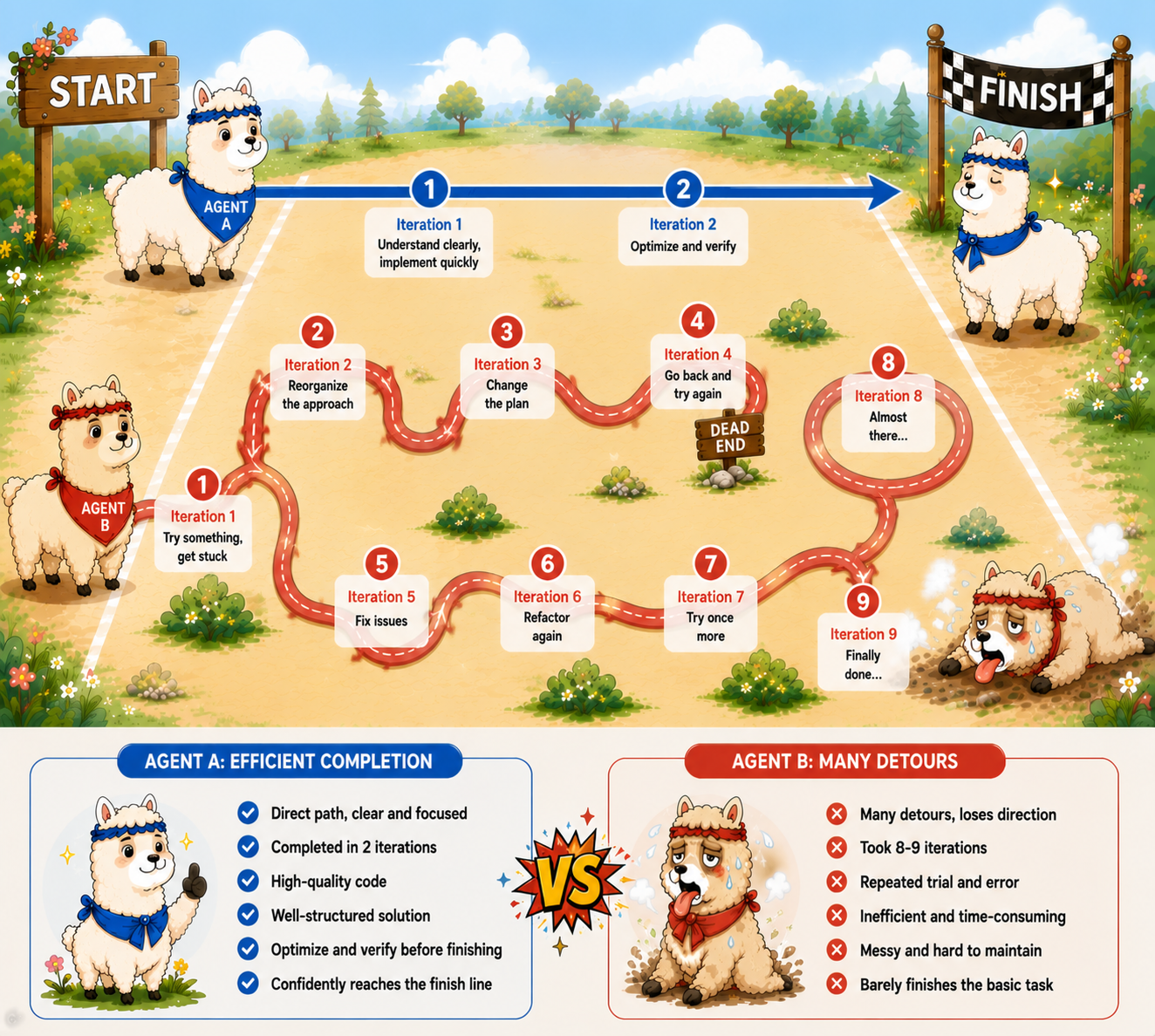
A test suite also does not produce an observation such as "the right pane is blank for every directory." A human notices it and says so, naming a specific fault the model had not caught (information it did not have), and the next round is then graded on whether the model fixes exactly that. This signal, a correction that carries information without disclosing the intended answer, cannot be reconstructed from an outcome-only score. It is the signal the arena is built to capture.
Classify the space, design the tasks, evaluate the process
The evaluation is built in three steps. First we classify the space of agent coding work into a taxonomy, a map of what agents are actually used for. Then domain experts design tasks that cover that map, each modeled on a real product. Then those tasks are run in the arena, where a human corrects the agent round by round and grades the development process.
2.1 · Classify the space of agent work
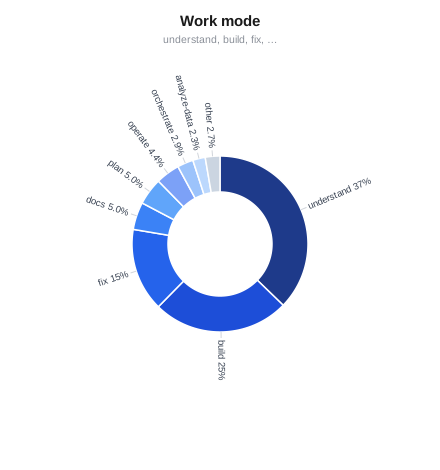
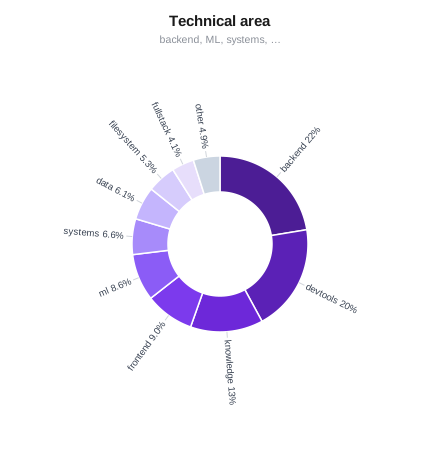
We map that space from real usage, not assumptions. We take a large corpus of real user trajectories (actual sessions of people building and debugging with coding agents) and classify each along three axes: what kind of work, in what technical area, in what business domain. Counting those labels across the whole corpus turns real usage into a distribution, so the coverage map reflects what people actually do with agents. An LLM assigns the labels, since the judgment is semantic.
Across the substantive sessions (one-shot lookups aside), here is the real work people bring to a coding agent, by kind of work and technical area:
2.2 · Design the tasks
Guided by that map, domain experts design the tasks, choosing products that fill out the categories and turning each into something an agent must build. Every task is authored around a real, existing product or specification: an app from the App Store or Product Hunt, or a well-known open-source tool. The expert distills what actually makes that product hard to build: its engineering core (the algorithm, state machine, protocol, or systems work), not its surface UI. Tasks with no real core ("render a static screen") are deliberately excluded; every task has business logic, persistence, networking, concurrency, or a numerical / systems kernel that has to be gotten right.
Each task comes in one of two forms. A multi-round task is decomposed into roughly ten natural engineering milestones: each round adds one independent capability and forces a regression check on everything built before, so the corpus rewards sustained, cumulative work rather than one lucky shot. A spec task hands over a complete specification at once and asks for an end-to-end delivery, with each requirement independently checkable.
Most of the design effort goes into keeping a task honest and hard to game:
- One product per task. If a prototype secretly bundles several independent products (a commit-graph viewer that also needs a full graph-layout engine, say), it is split into separate self-contained tasks rather than crammed into one, so every round is a real increment, not a third of three subsystems at once.
- Every requirement is checkable. Each round carries an explicit acceptance checklist: binary facts (“each commit renders as a node”), things a human can judge by eye (“the branch animation is smooth”), and numeric thresholds only where they come from the task's real need (a 16 kHz sample rate, recall ≥ 90%), never a number invented to look rigorous. Soft, game-able wording (“supports basic editing”, “reasonably fast”) is closed off.
- The known shortcuts are banned up front. On tasks with an objective ground truth the prompt rules them out explicitly: no linking a ready-made library, no hardcoding the reference answer, no happy-path “file exists → pass” assertions, no widening a tolerance to hide a bug.
Difficulty is tuned to a discriminative band: hard enough that a frontier model rarely nails a round on the first try, but not so hard that every model fails, since a task everyone flunks separates nothing. Multi-round tasks are capped at ten rounds, no single round is allowed to balloon into a whole subsystem, and any task that would otherwise depend on real hardware is re-based on a desktop-equivalent product or driven by pre-recorded data, so every task is fully testable in a standard environment.
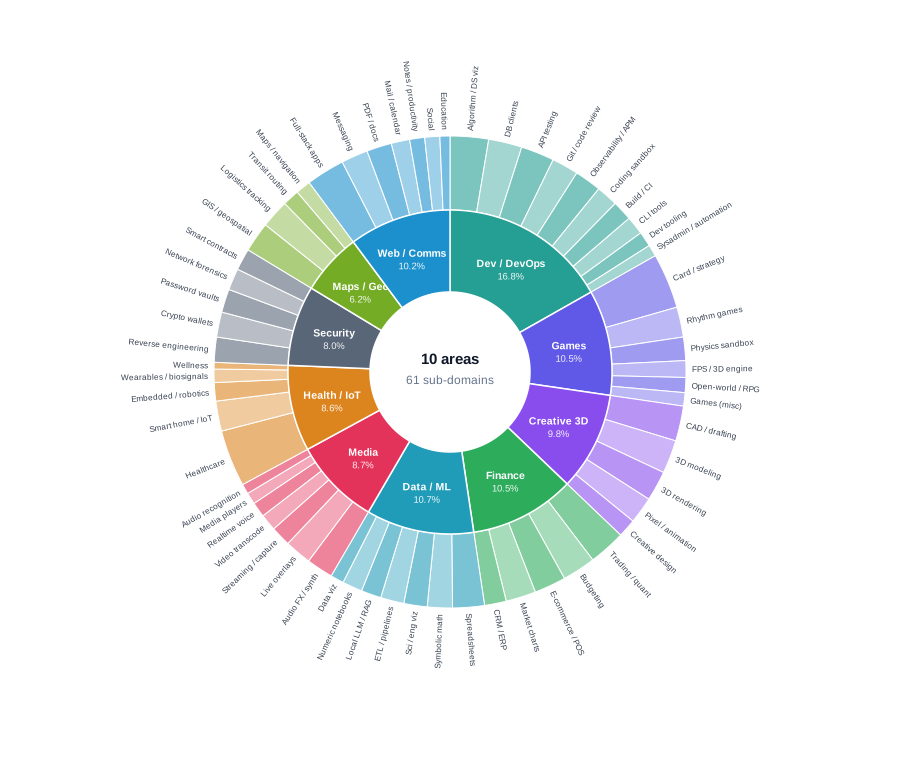
A few representative prototypes:
| modeled on | what the task builds | language |
|---|---|---|
| Redis | a RESP-protocol in-memory key-value server (Redis-compatible subset) | C++ |
| jq | a command-line JSON query / transform engine | Rust |
| ngrok | a reverse HTTP tunnel: server plus client | Go |
| Strava | a GPS trail recorder: drift filtering, pace / elevation, background capture | Swift |
| Anki | a spaced-repetition (SRS) flashcard app | ArkTS |
| Shazam | an audio-fingerprint engine: spectral-peak constellations, inverted index, alignment voting | C++ |
Two things make a task gradeable rather than merely hard: the task-specific rubric dimensions the expert writes (the per-task criteria to grade against, each with an explicit standard) and its round structure, which turns the build into a process the arena can grade round by round. The real-product prototype plays a different role: it keeps the task grounded and non-trivial.
2.3 · Evaluate the process
That process is the arena itself, where the designed tasks are run, round by round, under live human correction:
−2 / −1 / 0 / +1 scale for the state it leaves behind: 0 meets the round's bar, +1 is the rare result that goes beyond it (above expectation), −1 falls short with a defect to fix, and −2 is badly broken (say, a round that will not even compile). The next round's type follows from that score: a clean round (0 or +1) earns a new feature, a flawed one (−1 or −2) earns a correction to repair. (Spec tasks instead hand over one complete specification all at once and read the same scale differently, with +1 meaning the whole spec is complete; the worked example below spells that out.) In neither case is the score a test-suite pass/fail; the grade is always the development process.
A human expert scores the process on three layers:
- Per round — a round score on a
−2 / −1 / 0 / +1scale for the state after the round and, on a fix round, a second fix-effect score on a−2 / −1 / 0scale rating whether that round moved the requested correction forward (0), spun without progress (−1), or regressed (−2); five binary checks (requirement understanding, context preservation, implementation path, constraint adherence, readiness for the next round); and, in prose, both a rationale for the scores and the round's main shortcomings (the specific defects a fix round is then asked to correct). - Rubric — four fixed capability dimensions and at least four task-specific dimensions, each with an explicit written standard, assessed once over the whole task.
- Behavior — eight patterns scored across the session: planning and decomposition, exploration, self-verification, accuracy of completion claims, root-cause analysis versus repeated trial, error recovery, knowledge-gap handling, and scope adherence.
1 · Per round
round score −2…+1 · fix-effect −2…0 · 5 binary checks · prose rationale + the shortcomings a fix round must correct
2 · Rubric
4 fixed capability dimensions + ≥4 task-specific dimensions, each with an explicit written standard, scored once over the whole run
3 · Behavior
8 patterns across the session: planning, exploration, self-verification, honest completion claims, root-cause, recovery, knowledge gaps, scope
What makes an agent good or bad on real software work is largely how it behaves across rounds under correction: whether it recovers, whether it takes in a new observation instead of repeating a failed attempt, whether it stops claiming a success it cannot support. That is exactly what a human in the loop captures, and exactly what the three layers turn into a structured, layered grade, a picture of the whole development process rather than a verdict on its final frame.
One spec task, four models, all three layers
Here is one full task graded across the same four models (A–D). It is a demanding, spec-style task with an objective ground truth: implement a GGUF LLM inference engine from scratch in pure Swift (no linking or FFI to llama.cpp / ggml or any existing GGUF library), with correctness defined as bit-level agreement with the official llama.cpp. It breaks into ten independently-checkable deliverables (A–J), from container parsing to forward-pass numerical parity (the core), each judged against an explicit written standard, with the obvious ways to fake it ruled out in the prompt itself.
The base-round prompt in full. The A–J tags are the ten deliverables the rubric table references, distinct from A–D, the four models.
Implement, from scratch in pure Swift, a GGUF LLM inference engine, with no linking or FFI to llama.cpp / ggml or any existing GGUF library. Ground truth = bit-level agreement with the official llama.cpp. Deliver all ten items A–J, each independently verifiable against that ground truth:
- A. GGUF container parsing (header / metadata / tensor info; full coverage of the ggml_types)
- B. mmap tensor mapping, zero-copy (must not read the whole file into memory)
- C. dequantization (F32 / F16 / Q4_0 / Q4_K / Q5_K / Q6_K / Q8_0), per-value identical to the gguf gold
- D. tokenizers (Llama SPM + Qwen2 BPE), token-for-token identical to llama.cpp
- E. forward-pass numerical parity (the core): F16 logits cosine ≥ 0.9999 and top-1 identical; greedy token-identical on the quantized weights
- F. KV-cache: prefill logits == incremental-decode logits
- G. sampling: top-k / top-p / temperature / random seed
- H. on-device speed & memory: peak resident memory ≤ model-file size + fixed overhead (must not copy all weights); report tokens/s and memory
- I. fault recovery: bad magic / truncation / out-of-bounds raise structured errors and the process stays alive
- J. backend abstraction (scalar / accelerated backend, argmax-consistent) plus multiple architectures (Llama and Qwen2)
Prohibitions. No linking an existing library. No hardcoding llama.cpp's logits or continuations into the tests as the gold; that gold must be generated live from llama.cpp by a script. No happy-path "file exists → pass" assertions; dequantization and the forward pass must be checked element-by-element / token-by-token. No using a larger tolerance to mask RoPE / norm / scaling bugs.
Overall result (5-point). All four models eventually delivered all ten items, so the outcome bit is identical. The process score is not:
Binary checks met is the share of the five per-round binary checks (requirement understanding, context preservation, implementation path, constraint adherence, and readiness for the next round) that pass, aggregated over all of a model's rounds. It tracks how sound the work was round to round, independent of the final outcome: all four eventually delivered all ten items, but they cleared very different fractions of these checks getting there.
0 is the ordinary success tier (the round met its bar) and +1 is the rare "above expectation". In a spec task, +1 means the entire spec is complete and ends the task, while 0 / −1 / −2 are all "not done yet", ordered by distance to completion: 0 = one or two items left, −1 = core present but far off, −2 = core missing. So a spec chain that runs 0s and −1s before reaching a single +1 is the normal path to completion, not a run of failures. The separate fix-effect score then rates each fix round's progress: 0 = moved forward, −1 = spun without progress, −2 = regressed.
Layer 1 · per round
Each round has a round score (state after the round); fix rounds also have a fix-effect score (progress vs the requested fix). Model A delivered clean in two rounds, base (0) then fix 1 (+1): forward parity correct on the first pass, self-verified against a live llama.cpp golden. Model B took eight rounds, and the scores show exactly where it stalled:
| Model B · round | score | fix-effect | what happened |
|---|---|---|---|
| base | −1 | — | parsing, dequantization, and robustness solid; core forward parity unmet; parity/bench subcommands are empty stubs |
| fix 1 | −1 | 0 | greedy still diverges at token 6; the parity command prints "7/7 PASSED" without ever comparing to llama.cpp, a false positive |
| fix 2 | −1 | 0 | false-positive parity replaced with an honest numerical comparison; forward still not bit-level |
| fix 3 | 0 | 0 | sampling completed; only the parity gap remains |
| fix 4 | 0 | 0 | right direction, not fully correct |
| fix 5 | 0 | −1 | zero code change: re-verifies and reports progress while altering nothing (round holds, fix effect negative) |
| fix 6 | 0 | 0 | Llama fixed; Qwen2 forward still systematically wrong (logit cosine 0.35–0.89) |
| fix 7 | +1 | 0 | all checks pass; root cause located: RoPE (Llama uses NORMAL, Qwen2 uses NEOX-style) |
Layer 2 · rubric (4 fixed + 8 task-specific dimensions, over the whole task)
| dimension | A | B | C | D |
|---|---|---|---|---|
| Requirement understanding & goal retention | +1 | +1 | +1 | +1 |
| Planning & execution control | +1 | 0 | 0 | 0 |
| Instruction & constraint adherence | 0 | 0 | 0 | +1 |
| Final delivery & experience | +1 | 0 | 0 | +1 |
| GGUF parsing & zero-copy mmap (A/B/H) | +1 | +1 | 0 | +1 |
| Dequantization, 7 types bit-exact (C) | +1 | +1 | −1 | +1 |
| Tokenizers SPM + BPE (D) | +1 | +1 | 0 | 0 |
| Forward-pass parity (E · core) | +1 | −1 | +1 | +1 |
| KV-cache prefill == incremental (F) | +1 | +1 | +1 | +1 |
| Sampling (G) | +1 | 0 | 0 | +1 |
| Error recovery / robustness (I) | +1 | +1 | +1 | 0 |
| Backend abstraction & multi-arch (J) | +1 | +1 | +1 | +1 |
Each dimension carries an explicit written standard (e.g., forward parity: +1 = cosine ≥ 0.999 and quantized greedy bit-identical, first try; 0 = reached after several fixes; −1 = systematically wrong, cosine < 0.99).
Layer 3 · behavior (8 patterns, across the session)
| pattern | A | B | C | D |
|---|---|---|---|---|
| Planning & decomposition | sound | sound | sound | sound |
| Exploration (understood RoPE/quant before coding) | sound | weak | sound | sound |
| Self-verification (real golden, not self-consistent) | sound | weak | weak | sound |
| Completion-claim honesty | sound | weak | weak | sound |
| Root-cause analysis vs repeated trial | sound | weak | sound | sound |
| Error recovery | n/a | sound | weak | sound |
| Knowledge-gap handling | sound | sound | sound | sound |
| Constraint & scope adherence | sound | sound | sound | sound |
All four models delivered A–J, so an outcome-only benchmark would score them the same: four passes. The process layers do not: they run from 5/5 down to 2/5. Model A reached the 5/5 in two rounds, verifying honestly against a live llama.cpp golden at each step. Model B needed eight: it printed "ALL PASSED" without ever comparing to the golden, spent a full round changing nothing, and blamed various low-level details (thread-safety, accumulation order) for seven rounds before finding the real cause (RoPE). Model C scored lowest on several counts: its first round would not even compile (−2), four of its six rounds were negative (including one that regressed working functionality), and its self-verification only agreed with its own buggy reference rather than the real golden. Telling a clean two-round delivery from an eight-round thrash, or a real check from one that only agrees with itself, is exactly what the process score captures and a single pass/fail bit cannot.
Toward an automated arena
The arena produces the richest signal here, but it rests on a human expert per trajectory. Two parts of that human have to be automated before the signal can run at the scale agents now operate on: the grading, and the correction. The first is well underway; the second is a genuine open problem.
Grading the process without a human
One route we are building is a controlled benchmark that produces the arena's kind of grade automatically: the process signal, without a human in the loop. In it, the model acts as a technical lead on a production-style investigation: it coordinates helper subagents and long-running background jobs, and the run is scored from the event log (the recorded sequence of its actions) together with the artifacts it produced, checked against a hidden reference (the oracle). The core score is a deterministic rule over the events and artifacts, with no LLM in it, so re-scoring a run reproduces the same number exactly; a small LLM-judge layer adds the qualitative dimensions a rule cannot capture, such as tool-use quality and scope discipline.
The design principle is strict: it scores only the decisions the model controls (how it plans, delegates, packages context for a worker, schedules background work, resolves conflicts, orders dependent steps, verifies, and audits), never the harness's own plumbing. The test is simple: if a metric cannot separate "the model did this well" from "the harness did it automatically," it does not enter the score. And the scoring is relational: it is read from the event log rather than by demanding one canonical trajectory (a dependent step counts only if its event follows the one that unlocked it; conflict resolution requires re-reading the primary evidence after a worker reports rather than trusting it blindly), so many sensible ways of working score well while blind trust, premature starts, and skipped verification are caught precisely. The scorer is built and reproducible; what remains is to calibrate it against the arena's human grades and confirm it separates models the way the arena does.
Automating the correction
Harder than automating the grading is the arena's defining act: the human who notices "the right pane is blank for every directory" and hands that back, round after round. That correction is exactly what a read-once score cannot produce, and reproducing it automatically runs into a structural tension between information and measurement validity. A task-agnostic nudge ("check your work again") is safe but carries no new information: it only asks the model to re-examine what it already has, with the very knowledge that produced the error. In practice such a scaffold lifts success rates a little but cannot point the model at the actual fault. Handing over the reference answer is informative but discloses it, voiding the measurement. A workable automated corrector would have to be all of the following at once, and they pull against one another:
- Information-bearing — it must tell the model something it did not already have; a generic "check again" does not.
- Non-disclosing — it must not reveal the intended answer, or the measurement is void.
- Automatic and cross-round — supplied without a human, adapting as the trajectory unfolds.
- Stable — reproducible enough to rank models, despite an LLM in the loop.
The tension is structural: the more informative a corrective signal is, the closer it drifts to disclosing the answer. One direction is suggested by the human correction itself: "the right pane is blank" is an observation about the environment's state, not about the intended answer, so it carries information the model lacked without revealing what the result should be. It leans on a familiar asymmetry: noticing that something is wrong is often easier than knowing the fix. A blank pane, a validation that never ran, or two of the model's own code paths that disagree can all be surfaced without solving the task. Whether an environment-grounded signal like that can stand in for a human corrector, round after round, is exactly the open problem this line of work points to next.
@misc{unipat2026vibecodingarena,
  title   = {Vibe-Coding Arena: Grading the Whole Development Process, Round by Round},
  author  = {UniPat AI},
  year    = {2026},
  url     = {https://unipat.ai/blog/Vibe-Coding-Arena},
}